The Warning Most Adults Never Get At Diagnosis: Why You Can Be Fully "Treated" For ADHD And Still Lose Every Single Day

You did everything you were told to do.
You waited for the assessment. Months, probably. You answered the questionnaires, dug up your school reports, sat through the interview.
You got the diagnosis.
You got the prescription. Maybe the dose got adjusted once or twice until it felt right.
And then Tuesday happened anyway.
The inbox you couldn't open. The form that sat there for eleven days. The evening that vanished. The thing you swore you'd start at 9am and started at 4pm, badly, in a panic.
You are being treated. And the day still falls apart.
Here is what a prescription was never designed to do
This is not a criticism of medication. It's a description of its job.
- It does not decide what you work on first when eleven things are urgent.
- It does not break a task into steps small enough that starting is possible.
- It does not tell you what to do when the shame arrives at 4pm and takes the rest of the day with it.
- It does not build a system that survives a bad week, a bad night, or a missed dose.
- It does not undo twenty years of believing you're the problem.
Medication treats the symptom. It does not teach a single skill.
That's not your treatment failing. That's the half of the treatment nobody handed you.
Nothing on this page is a reason to change, reduce or stop your medication, and nothing here is medical advice. If your treatment isn't working the way you hoped, that is a conversation for the clinician who prescribed it — not for an article. What follows is about the part that sits alongside treatment, not instead of it.
The half that never gets prescribed
Here's the part that surprises people: this isn't a fringe opinion. It's already written into the guidance clinicians work from.
Treatment guidance for adult ADHD doesn't stop at the prescription pad. It specifically addresses the case of an adult who is on medication and still impaired in daily life — and what it recommends for that person is structured, skills-based, non-medication support. The kind built on CBT and ACT.
Read that again, because it's the whole point of this article.
The situation you're in — medicated and still struggling — is common enough that the guidelines have a specific instruction for it.
You are not an edge case. You are the case they wrote the line for.
"People arrive already medicated and completely exhausted," David says. "The dose is usually fine. Nobody ever gave them the other half."
But here's the practical problem, and it's the reason so many adults never get that second half:
There is no pharmacy for skills.
Nobody hands them to you at a counter. There's a waiting list, or a specialist who doesn't take your insurance, or a therapist who is excellent at anxiety and has never worked with ADHD. So the second half quietly becomes a thing you're supposed to figure out on your own.

What the medication actually gives you

Ask people who respond well to their medication what changed, and you get a strikingly consistent answer.
Not "I became organised." Not "I stopped procrastinating."
"The noise dropped."
The volume comes down. There's a window — an hour, three hours — where the static is quiet enough that you could, in principle, do the thing.
That window is real, and it matters enormously.
But notice what it is. It's capacity. It isn't instructions.
Nothing about a quieter brain tells you which of the eleven urgent things is actually the first one. Nothing about it makes a task feel startable when the task has no visible first step. Nothing about it catches you at 4pm when one piece of critical feedback flattens the rest of the week.
So a lot of adults end up with the strangest version of stuck: the window opens, and they spend it staring at it.
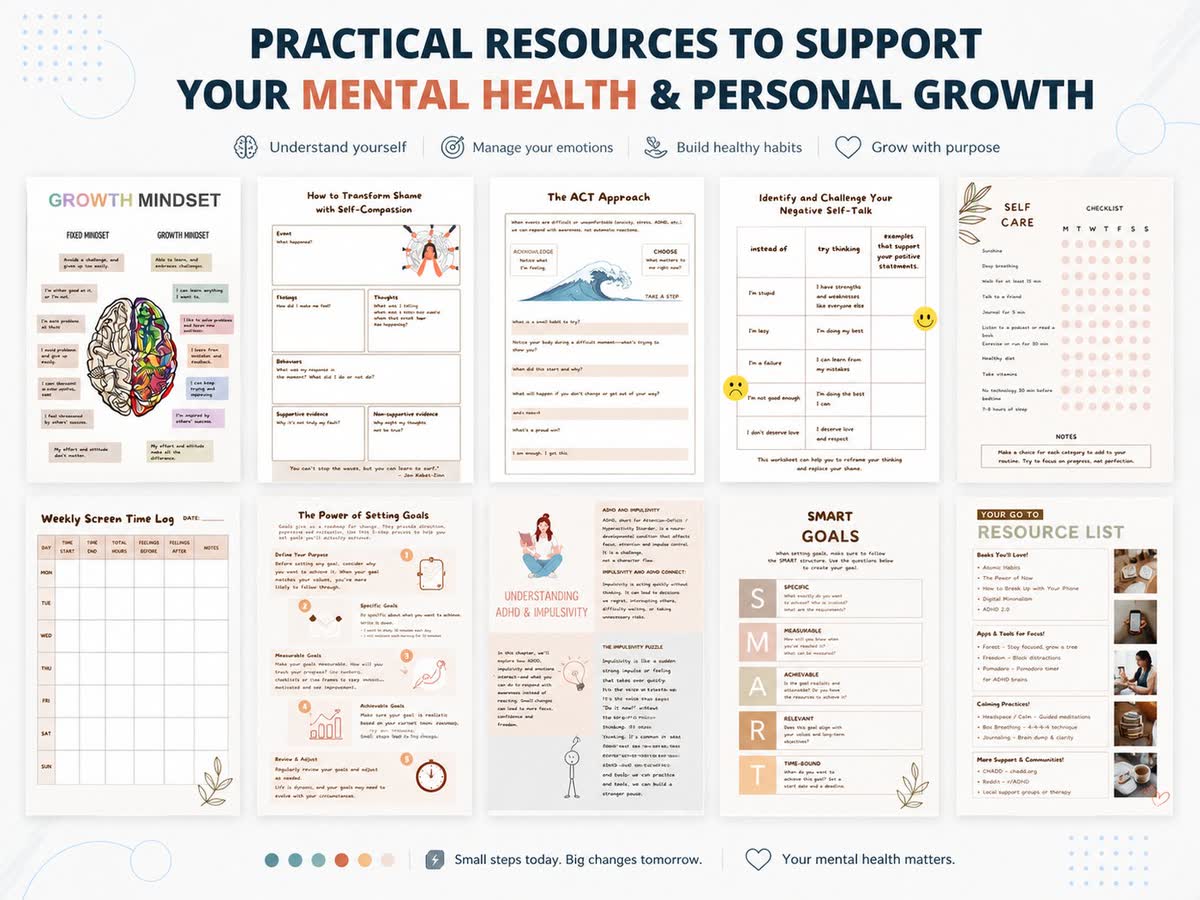
If you already know exactly which half you're missing, it's below — 4 workbooks, 123 pages, one idea per page.
See the Pack — $37 →"Then just use a planner"

You've heard this one. You've probably bought several.
And here's why the beautiful planner is in a drawer with three of its friends: a planner assumes the skill it is supposed to replace.
It assumes you can estimate how long something takes. It assumes you'll open it tomorrow. It assumes that writing the task down is the hard part.
For an ADHD brain, none of those are true. Writing it down was never the problem.
The books have the same flaw in a different shape. Three hundred pages, sixty of them theory, the actual tools somewhere in chapter nine — and getting to chapter nine requires exactly the capacity the book is supposed to be building. You pay upfront, in the one currency you don't have.
So the second half of the treatment stays undone. Not because you didn't want it. Because everything offering it was built wrong.
What the missing half actually looks like on paper
David B is an ADHD coach. He didn't set out to build a product — he set out to make something his wife could actually finish after her diagnosis, when the pile of books they'd bought had turned into a pile of things she'd failed at.
He gave himself four rules. They're almost aggressively simple, and every one of them exists because of how the last thing failed.
1 · One idea per page. No exceptions.
If a page teaches two things, it teaches neither. Turn the page and the previous idea is done — closed, complete, no thread left to hold.
2 · Every page has something to fill in.
Not busywork. A blank that turns reading into doing on the same page, in the same minute, while the idea is still warm. You cannot passively consume a page that's waiting for your handwriting.
3 · Nothing longer than one sitting.
A section you can finish before your attention leaves the building — the kind of thing that fits inside the window, instead of needing three of them.
4 · Real CBT and ACT tools, without the clinical vocabulary.
The methods underneath are the ones used in therapy for adult ADHD. What got stripped out was the language that makes people feel they need a degree to use their own coping strategies.

Choose the first task. Make it startable. Catch you at 4pm when one comment takes the rest of the week.
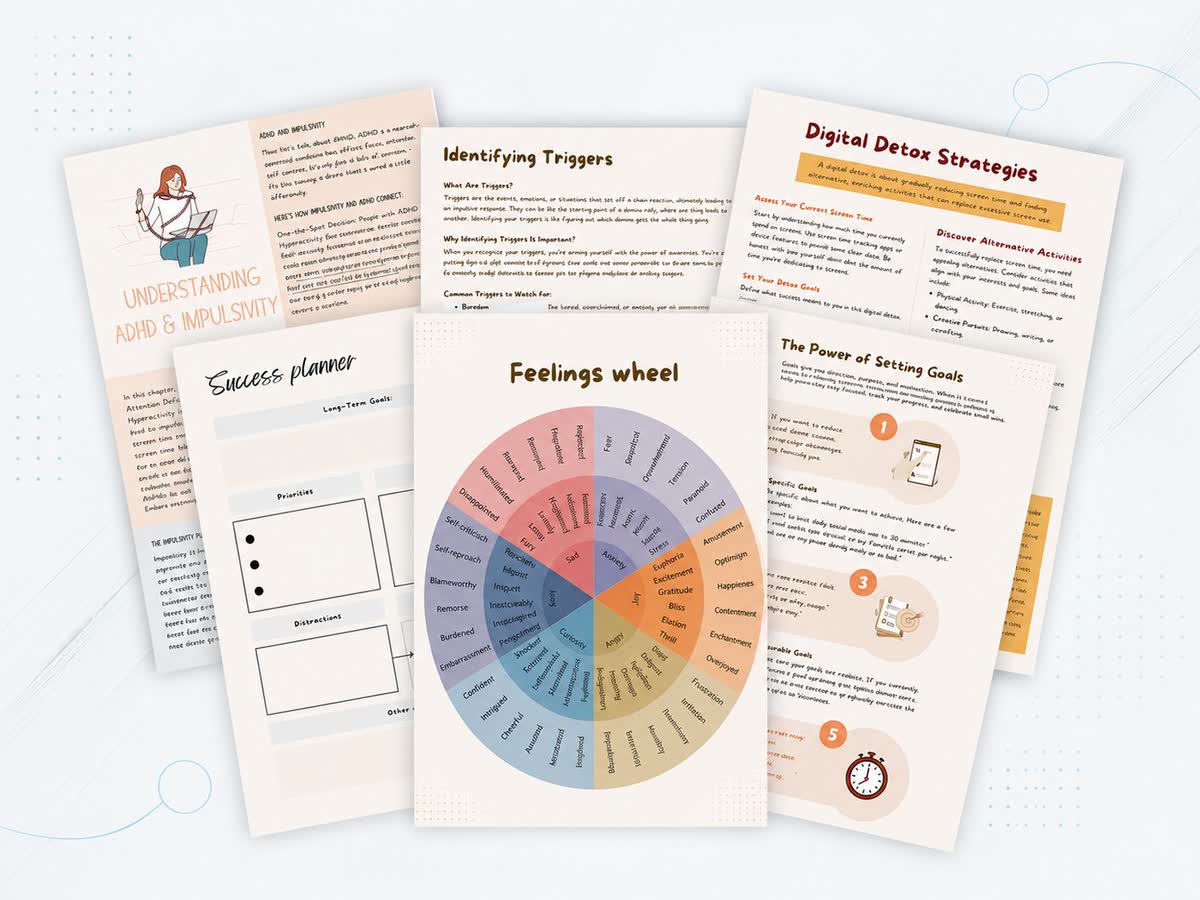
One idea, one prompt, room to answer. Finished in the time the window is actually open.
Medication alone
- Turns the volume down
- Gives you a window of capacity
- Works while it's in your system
- Teaches no skill you keep
- Needs an appointment to adjust
- Says nothing about the 4pm crash
Medication + the second half
- You know what to put in the window
- A first step small enough to start
- Tools that stay yours after a missed dose
- Skills built one page at a time
- No appointment, no waiting list
- A plan for the shame, not just the focus
These workbooks are self-help materials designed to sit alongside professional care. They are not a treatment, and not a replacement for one.
The four workbooks
123 pages in total. Meant to be worked through in order, but nothing breaks if you don't.
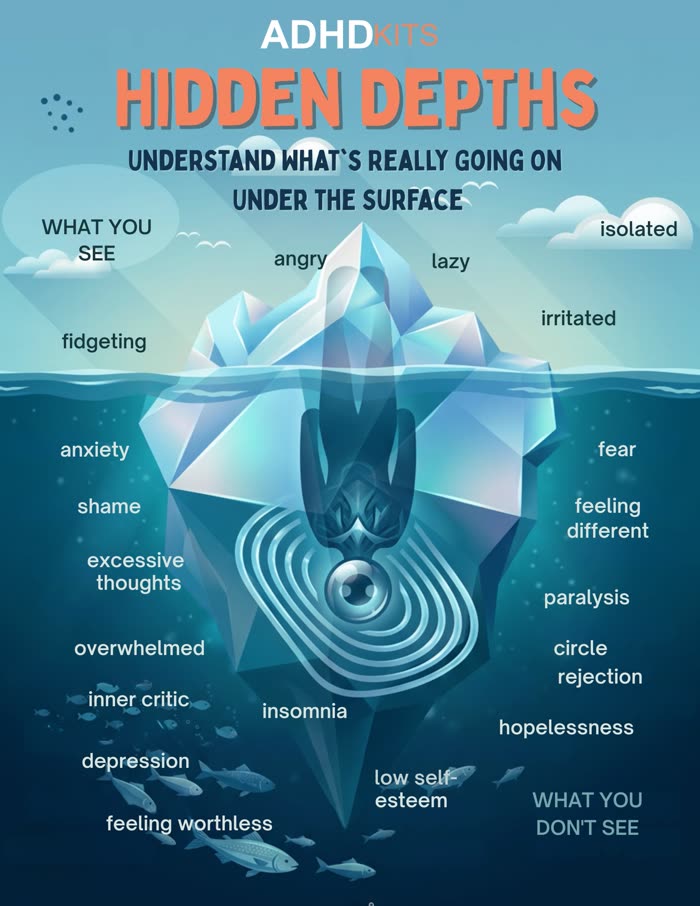
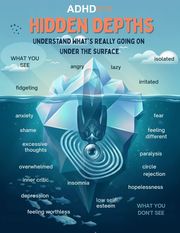
01 · Hidden Depths
The shame, anxiety and inner critic sitting underneath the visible symptoms — the part medication doesn't reach — mapped, then worked on with CBT and ACT tools.
28 pages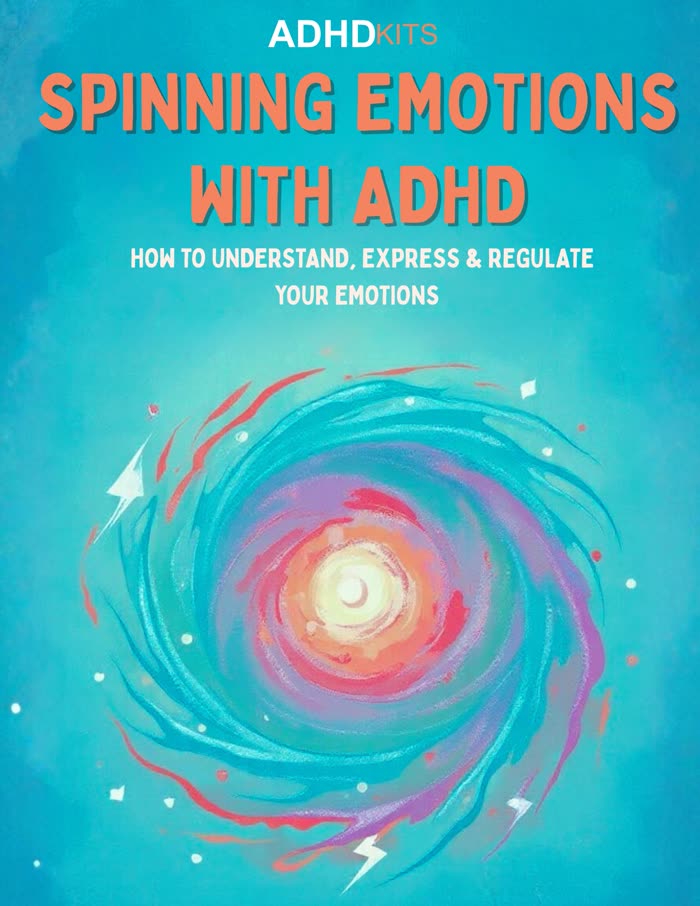
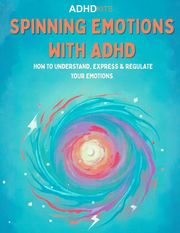
02 · Spinning Emotions
Name and regulate the intense stuff — rejection sensitivity, anger, and the overwhelm that arrives out of nowhere and eats the afternoon.
25 pages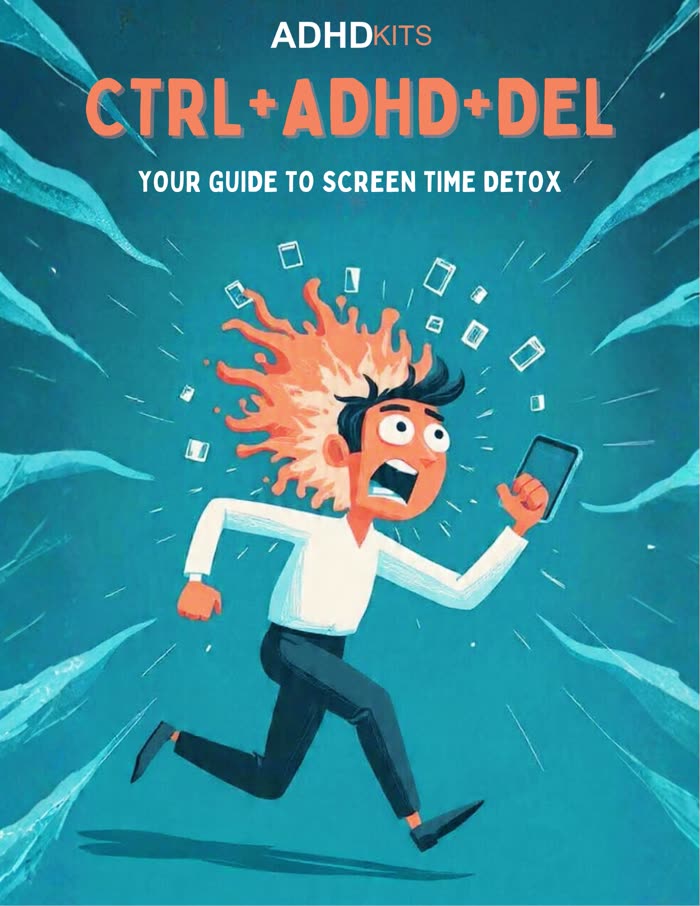
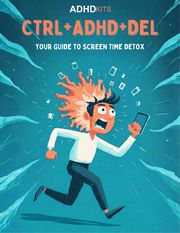
03 · CTRL+ADHD+DEL
The dopamine loop behind endless scrolling, and a 100-day challenge to get the window back from your phone.
44 pages
04 · ADHD Ventures
Track your patterns, find your actual strengths, and set goals sized for the brain you have rather than the one you keep apologising for.
26 pagesWhat readers say

"The Iceberg workbook made me cry. I finally understood why I've been so hard on myself my whole life. Absolutely life-changing."
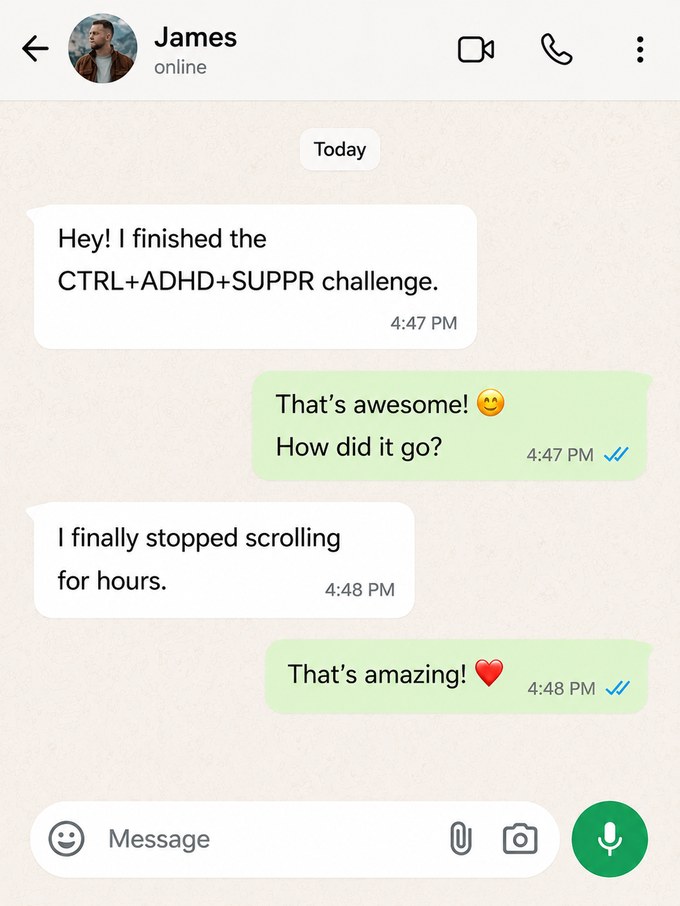
"CTRL+ADHD+DEL is the only thing that helped me stop doom-scrolling. I've tried everything. The dopamine reset challenge actually works."
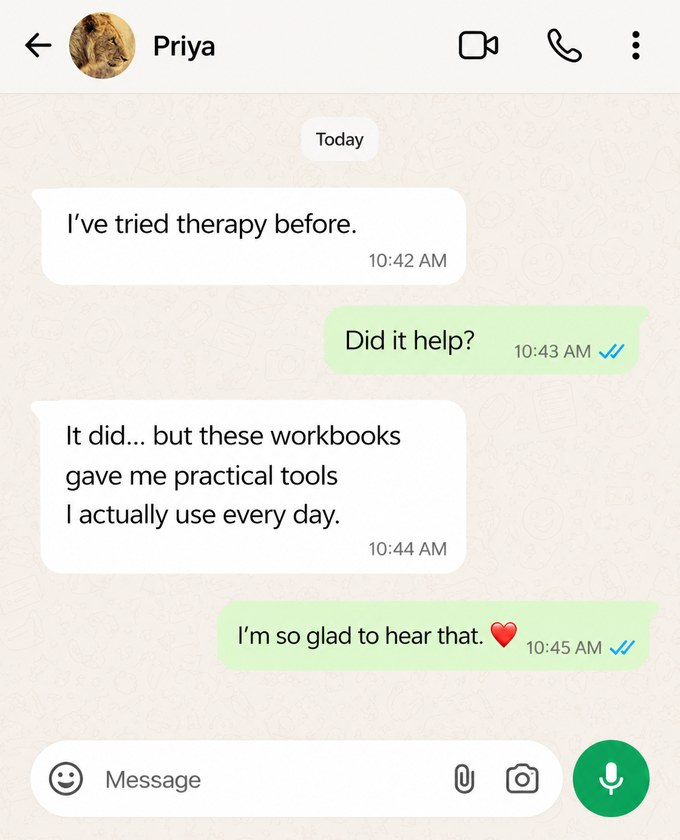
"I've spent thousands on therapy. These 4 workbooks gave me more practical tools than most of my sessions. Worth every penny."
*Individual results vary. Testimonials reflect the personal experience of individual customers.
"I've already tried this kind of thing"
Fair. Most people reading this have a drawer that proves it.
So here's the honest version of what's different, with no mystique attached: the information isn't secret. CBT and ACT tools for adult ADHD are well documented. You could assemble them yourself over a few hundred hours of reading — which is, of course, the exact task the ADHD makes impossible.
What's different is the delivery. One idea per page. A blank on every page. Sections short enough to finish inside the window you actually have.
It's $37 for all four workbooks. About 30 cents a page — less than a single hour of therapy, and it doesn't expire, renew, or need an appointment.
And if it turns out to be one more thing for the drawer, you get your money back for 30 days. No form, no interrogation. One email.
The Complete ADHD Pack
All 4 workbooks · Instant download · Yours forever
Launch price ends in
One-time payment · No subscription · No upsells
Get the Pack — $37 →🔒 Secure checkout · Instant download · 30-day money-back guarantee
⭐ 4.9/5 from 2,000+ readers
Money-back
guarantee
Instant
delivery
From 2,000+
readers
Yours
forever
One last thing worth saying
If you're medicated and still struggling, the conclusion you've probably drawn is the one everybody draws.
"Even with help, I can't do it. So it must be me."
Look at what actually happened instead. You were given one half of a two-part treatment, and then judged on the result as though you'd been given both.
The window was never the problem. Nobody ever told you what to put in it.
That part is learnable. It just has to be written for the brain that's learning it.